Naga Fireballs
(October 4, 2009: At the Wat Thai temple City Pillar Shrine, Nong Khai Province)
Note: Event dates and programme details may be subject to change. To ensure you have the most updated information, please reconfirm details prior to travel.

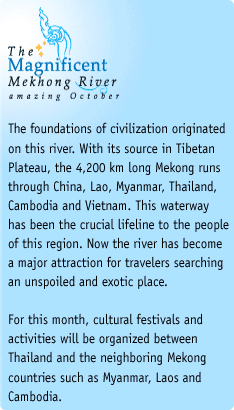
As the full moon crests the horizon, ruby orbs of light begin to rise out of the Mekong River. As if by magic, they float silently into the air and then evaporate in the inky blackness, a phenomenon that awes and delights observers privileged to have seen them.

For centuries, their existence was a closely-held secret among villagers living near the northeastern town of Nong Khai. Then, the miraculous event was discovered by outsiders who now flock to the riverbanks each October full moon night in enormous numbers-400,000, at last count.

The silence of the fireballs' ascent is emblematic of the mystery of their origins beneath the murky Mekong. Villagers claim that they are created by nak, mythical serpents as central to Thai belief and as enigmatic as the fireballs themselves.

The debate over their formation reflects a clash of cultures. On the one hand are the villagers for whom water and its denizens holds an almost mystical fascination. And little wonder: water nourishes the staple foods of rice and fish; it is central to every rite, festival, and procession from the Royal Barges to longboat races. Rivers and canals once supported most Thais' boats and homes, and water explains every elemental mystery. For a people who cling dearly to cherished beliefs about water-and especially about its chief denizen, the nak (naga, in Sanskrit)-the scientists' desire to find a rational explanation for the phenomenon, is an abomination. Faith and tradition vie with science.

Between 6 and 9 p.m. on the full moon night of the eleventh lunar month (October), the final night of Buddhist Lent, smokeless, scentless, soundless fireballs begin to rise from the deepest, Lao side of the Mekong. As many as 19 ruby globes at a time ascend to heights of 30 to 300 metres for three to eight seconds each, then simply vanish. In some years there are only a few; in 1999, nearly 3,500 fireballs were counted. They can be seen from ponds and a dozen riverbank villages but are most numerous near Phon Phisai.

The villagers' assertion that the nak are responsible for the miracle rests on an ancient Buddhist legend.

During his final incarnation, Lord Buddha returned to earth after teaching his mother in Thavatimsa heaven at the end of Buddhist Lent. Phaya Nak and his followers welcomed him back by blowing fireballs into the sky. Since then, on the October full moon night, fireballs-regarded as the fiery breath of the nak, mirroring medieval European beliefs of fire-breathing dragons-have risen from the Mekong River, a miracle that people call "Bang Fai Phaya Nak," in recognition of the serpent king's devotion.

On the preceding afternoon, villagers in traditional dress parade through Phon Phisai, accompanied by bands, and floats bearing images of the nak. In the evening, illuminated longboats float by the crowds gathered on the riverbanks. When the procession has passed, onlookers settle in to wait for the magic to begin.

Many villagers claim to have glimpsed the gigantic nak, a belief supported in some respects by science. Paleontologists say gigantic aquatic snakes termed Madtsoids appeared worldwide in the Cretaceous period. Fossilised vertebra found in South American suggest a serpent 18 metres (60 feet) long and a metre in diameter, near the size the villagers say they have seen. The ancient creatures also bore crests resembling those of the naga. Could descendents of the Madtsoids inhabit the depths of the Mekong River, much in the way that the pseudoryx, once thought extinct has surfaced in the mountains of northeastern Laos?

But, on the other hand, science has challenged folk belief in the fireballs and fired a controversy. It began with skepticism by one of Nong Khai's own citizens, Dr. Manas Kanoksilpa, who for a decade has conducted scientific experiments to explain the fireball phenomenon. Dismissing a human hand in their creation (a charge initially levelled at the villagers), he says that the Bang Fai Phaya Nak are globules of methane and nitrogen formed from decomposed organic matter trapped in pools deep beneath the Mekong. When the balls break the water's surface, they self-combust and remain alight until they eventually run out of fuel and fade. This is the explanation generally given for the formation of swamp gas and will-o'-the-wisp.

In 2002, the Ministry of Science and Technology appointed a committee of experts to study the issue. The team collected soil and water samples, developed a submarine robot to probe the riverbed, and set up eight gas-collecting and gas-monitoring stations in swamps and rivers where sightings had been reported. After a two-year study, they concurred with Dr. Manas that the fireballs are caused by the sun warming organic matter on the riverbed, causing it to decompose into flammable phosphine and methane gas and combust in the presence of ionised atomic oxygen. This explains why the fireballs are of uniform colour, do not emit flares, smoke or sound, and eventually dissipate without a trace.

Tracking studies have indicated that the phenomenon occurs in March to May, and September and October, when the earth is closest to the sun. But the committee sidestepped the question of how the fermented matter could form in swiftly-running water. Anticipating adverse reaction to their investigations, the Ministry announced that the Royal Thai Navy would also monitor the fireballs with equipment installed along the riverbanks.

Naturally, the findings have been disputed by Nong Khai residents who see their time-honoured beliefs challenged by what they view as attempts to portray them as superstitious country bumpkins.

Secular conviction or swamp gas?
Superstition or science?

The debate rages on. What cannot be disputed is the fireballs' beauty. For those who have seen them, they are wondrous, whatever the explanation. So, each full moon night in October, spectators gather on the riverbanks to await the miracle. And secretly hope for a chance sighting of the nak himself.

Contact information:
Tourism Authority of Thailand, Udon Thani Office
Areas of Responsibility: Udon Thani, Nong Khai
Tel: +66 (0) 4232 5406-7
Fax: +66 (0) 4232 5408
E-mail: tatudon@tat.or.th

About The Author
Steve Van Beek
Steve Van Beek's special intimacy with water comes in large part because for 11 of his 30 years in Thailand, he lived in a wooden Thai house set on stilts in the Chao Phraya River. He has also paddled a small boat down all of the Chao Phraya's four tributaries; his "The Chao Phya, River in Transition" which was published by Oxford University Press is considered the definitive work on the river and water culture in Thailand. His most recent book, "Slithering South" is an anecdotal chronicle of his first journey. The author of 21 books and 42 documentary films on a variety of Asian cultural topics, he is a Fellow of the Explorers Club in New York, elected in recognition of his solo river expeditions in China and Tibet.


Note: Event dates and programme details may be subject to change. To ensure you have the most updated information, please reconfirm details prior to travel.


Link to the Tourism Authority of Thailand


Please note that there is usually the scarcity of accommodation during some festivals such as Loi Krathong and Songkran . In that case, early booking of at least one month before the festival may be required.

This website is powered by Circle Of Asia Travel


   Sponsored by  Circle of Asia
Copyright © 2002-2009  ThailandGrandFestival, All Rights Reserved.